

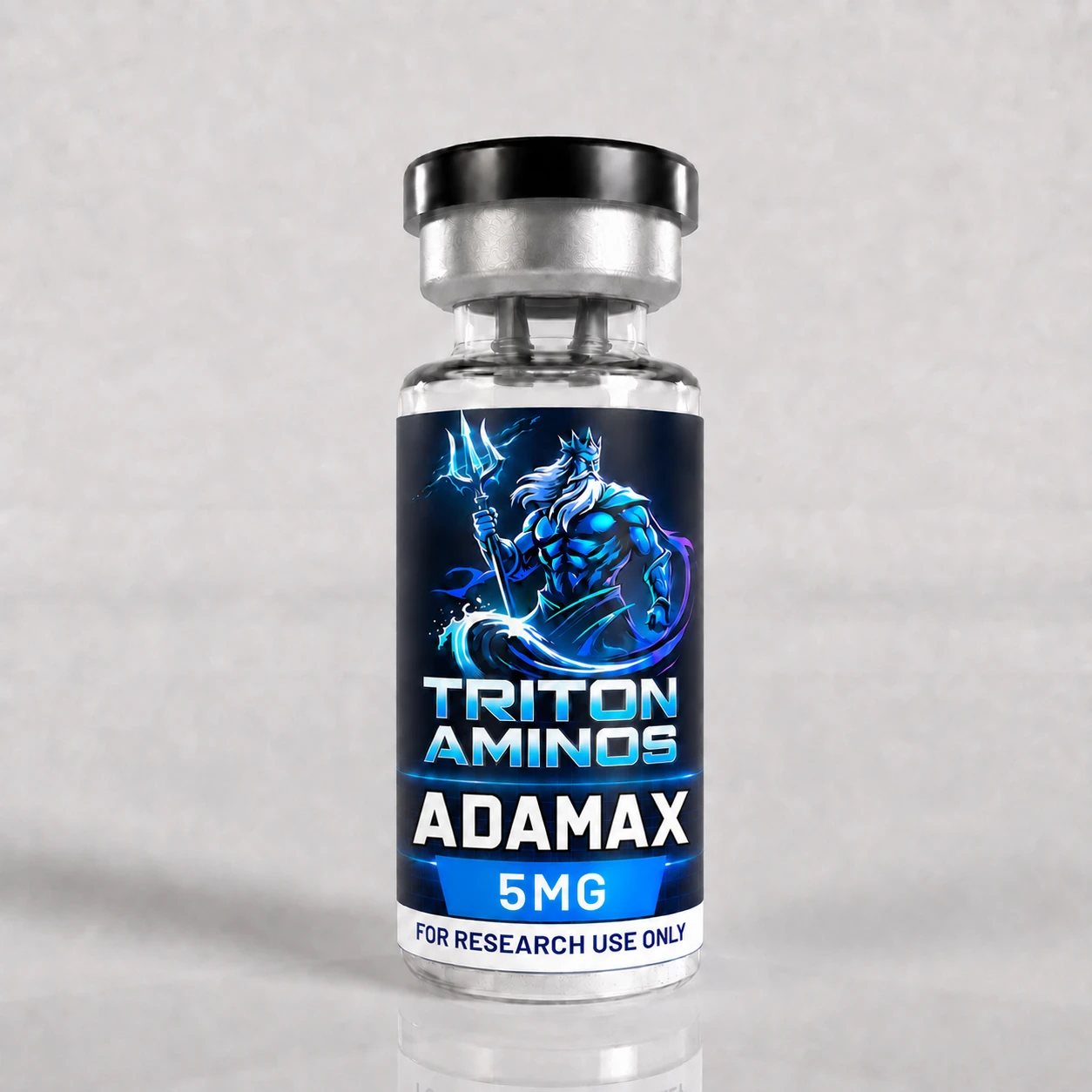
Adamax (N-Acetyl, Adamantane-Modified Semax Analog) – 5MG Research-Use-Only Peptide
Adamax (Ac-MEHFPGP-AG-NH2) is a synthetic heptapeptide analog derived from Semax, itself a well-studied ACTH(4-10) fragment analog. Adamax carries two structural modifications relative to unmodified Semax: an acetyl group at the N-terminus and an adamantane moiety at the C-terminus, a feature it shares with the related peptide P21. This product is provided in a 5 mg vial formulation intended solely for controlled research environments.
Research Context
Semax has been studied since the 1980s for its neurotrophic and cognitive research applications without exhibiting the hormonal activity of its ACTH parent sequence. Adamax builds on this scaffold, with its terminal modifications proposed to increase metabolic stability and lipophilicity, which researchers have theorized may improve blood-brain barrier penetration relative to unmodified Semax. As a newer analog, published research specific to Adamax is more limited than for Semax itself, and current claims about its activity are derived substantially from structural analogy to Semax and P21 alongside early-stage laboratory use.
Research Overview
Preliminary research interest in Adamax has focused on brain-derived neurotrophic factor (BDNF) expression and TrkB receptor sensitivity, particularly in hippocampal models, along with potential downstream effects on dopaminergic, noradrenergic, and serotonergic signaling. These investigations remain exploratory, and researchers should treat mechanism-of-action claims for Adamax as hypotheses under active study rather than settled findings.
Key Research Focus Areas
- Neurotrophic Signaling: Investigation of Adamax’s influence on BDNF expression and TrkB receptor activity in hippocampal and cortical models.
- Blood-Brain Barrier Penetration: Study of how the acetyl and adamantane modifications affect central nervous system bioavailability relative to unmodified Semax.
- Neurotransmitter Modulation: Examination of downstream effects on dopaminergic, noradrenergic, and serotonergic signaling pathways.
- Cognitive and Attention-Related Models: Use in preclinical models exploring attention-, learning-, and memory-related endpoints.
- Comparative Structure-Activity Relationships: Contrast with Semax and P21 to clarify how terminal modifications influence potency, stability, and receptor engagement.
Cautionary Statement
Adamax is a research chemical and should only be handled by qualified personnel within approved academic or institutional research facilities. This product is not intended for human or animal consumption and poses significant risks if misused. Users must adhere to all applicable laboratory safety protocols, including proper disposal procedures for peptide waste. Always consult relevant institutional review boards and ethics committees prior to initiating research activities involving Adamax.
For research use only. Not for human or animal consumption.